Given to Smoking
"If I stopped I might be thinking: ‘what flavours could I have found?’”

A version of this article first appeared in the Friday, 18th April, 2025 issue of The Shetland Times.
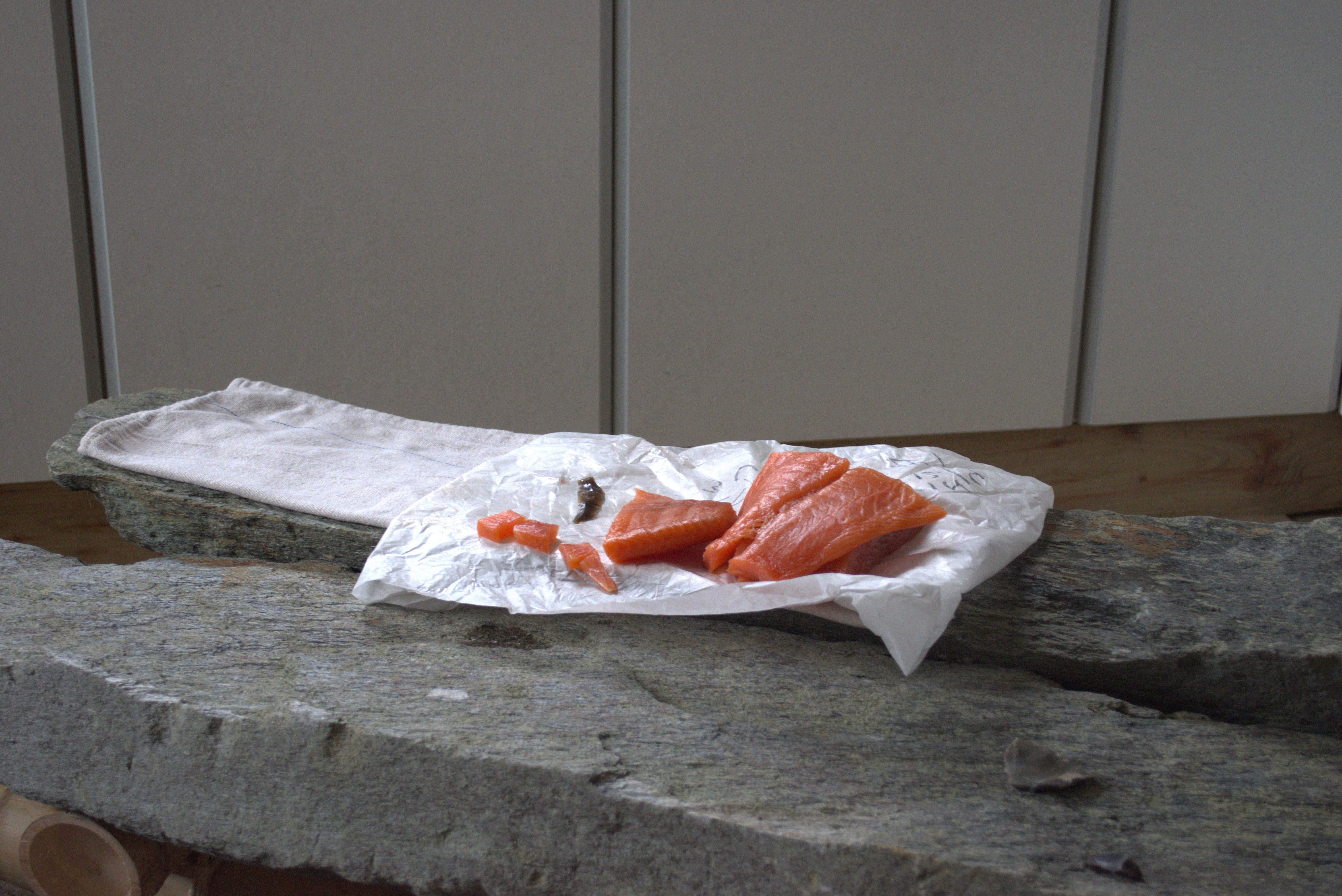
Near the southern end of the remote Shetland Islands, halfway along the burn of Maywick and past a small “smoke house” sign, a man in a shed kneels at his shrine of bamboo and ancient stones to ritually desecrate a flank of salmon.
Casting a shard of flint aside, David Parham picks up a Spanish knife with a wooden hilt and marquise-shaped metal blade.
“You have to treat it like a devotional religion,” he says, carving away a slice. “I’m forcing myself to get up earlier, go to bed earlier. It’s a whole mindset.”
In the spirit-world of smoked salmon, Parham has just committed a cardinal sin. Metal, food scientists tell us, oxidises with delicate salty foods and dulls the flavour. This is a demonstration of what not to do.
“There’s a lot of wrong that’s happened with the food industry. I’m trying to put something right.”
I am here because, after three decades of tinkering – building smokers from scratch, studying East Asian seafood and chasing down the forgotten scents of steam trains from his childhood – Parham says he has reached the final horizon on his quest for flavour.
“Most people just want smoky. That’s not good enough when I can adjust the taste: more bonfire-y, more bitter,” he says. “I’m looking for pure flavours.”
Born into a fishing family in Devon, Parham has spent his life with fish: first catching, then gutting, then keeping a stall at the only shopping centre on Britain’s rugged, northernmost archipelago. Now he runs the Handmade Fish Company, and takes me into the smokeroom (his shed) to see the setup.
A small mesh basket filled with woodchips sits over a Bunsen burner, all covered by a large, steel upside down kitchen strainer. That funnels the smoke into a fish kettle Parham has fixed with bamboo rungs (to stop the fish touching any metal).
Standing in a pink hoodie and wellington boots, Parham speaks readily and unselfconsciously in aphorisms like “smoked salmon is a part of life, we all know it”, or “if you want to know good smoked salmon, you’ve got to eat good smoked salmon” or “when a salmon dies, it actually comes alive”.
When he reaches the smoker itself he says: “You can’t will smoke to work; smoke has a will of its own.”
The final revelation? Last month Parham unlocked a new way of smoke-whispering.
“I’m hoping that through time I can relax into this sort of old-age artisanry, and be comfortable with it.”
The key to a good smoke is getting the wood to burn long and cool, so it sinks over the fish in a loving bath as it floats through the kettle. The sweet spot is 290C. Packed too loosely and the chips will burn hot and fast, too tight and they’ll not breathe, nor burn, at all.
Parham lines a countertop with five sooty mesh woodchip holders. Starting with a conventional kitchen sieve, these are the stepping stones of a perfectionist.
He holds the last two up – identical apart from one key detail he will not have published for commercial reasons. One was not quite right; the other is, at last, perfect.
“I was gobsmacked,” he says. “There are only certain things you can do that the smoke will accept.”
Getting here has not been easy.
For some time just eliminating metal was hard enough. First Parham bought in a set of ceramic knives but the taste, he says, was not quite right. Cracking them open he found each blade had a hidden metal part. Good enough to stop ne’er-do-wells sneaking through security, but not getting past Parham.
His telepathic tastebuds can even, he says, look back into the life of the salmon he is eating.
Like us, stressed-out fish panic. The lactic acid left from their death throes stays in the flesh, albeit imperceptibly at first. As a fish is aged, though, that acid kills some of the microbes that might otherwise flourish into new and subtle flavours.
“For years I was blaming myself,” Parham says ruefully. “Imagine working on something for 18 days and you’ve no idea what it’s going to be like and then eventually you can taste it. Jesus, what a waste of time.”
Now Handmade Fish only works with one supplier – another commercial secret – which cools fish to chill them out, then electrically stuns them and hits them on the back of the head before bleeding them to death. The final product has never been so serene, according to Parham.
What does the fish taste like? Over an afternoon talking and eating, Parham only struggles for words twice – when he is eating salmon, and when he tries to describe its flavour.
“I was worried we were going to need to try and put into words the stuff that you can’t really put into words,” he laughs, a little nervously. “I still can’t figure that out.”
I ask him to try.
“If you’re passing a proper wood bonfire,” Parham begins. “If you really think about it, if you’re aware of the smoke – you’re going to get lots of different smells. And if you convert them into flavours,” he trails off, then restarts with an example.
“When I was a kid we still had steam trains on the main railways – that was this one smell-flavour that, for me, is very ancient.”
Parham now recreates that memory with flakes of binchō-tan in his woodchips – a white Japanese charcoal so dense it destroys most conventional cooking knives.
Parham talks about salmon tasting like wine; he wants long and subtle flavours. He talks about smoking like great art.
“There’s no sort of path that I follow.” Often ideas will come to him in the dead of night, he says. “Although I have sort of made it happen it’s a very unconscious thing.”
Handmade Fish also smoke haddock, but Parham says he basically got that right first time round, back in 1998.
Kneeling at the salmon shrine Parham returns to his flint shard – sourced from a beach in Norfolk – trims away the edge of fish which any metal has touched, cuts a new slice and offers it to me.
“I really struggle a lot of the time thinking ‘why am I going to bother?’” he admits. “It’s not something that I find easy to do, but I know I’ll never settle for anything other than what I want.
“I’m hoping that through time I can relax into this sort of old-age artisanry, and be comfortable with it.”
In the 2011 cult documentary Jiro Dreams of Sushi, director David Gelb captures a wizened master chef at the end of a 75-year search – not for perfection, but for the next bite to taste better than the last.
Critics, not unlovingly, saw a “cast of obsessives”. Parham saw himself.
The truth is, Parham’s search for flavour will not finish with the latest tweak. It may never end at all. “I’m getting flavours now that I’ve never gotten before,” he says. “And so if I stopped I might be thinking: ‘what flavours could I have found?’”
Already he is mulling the idea of an entirely wooden smoker, or introducing blackthorn chips to taste the same smoke Vikings would have known.
“I’ll never quit, because it’s too exciting.”
Lovely piece
👏