Wind Up Act
Just Stop Oil, Grab a Granny and Ness Monstrosities.

A version of this article first appeared in the Friday, 18th July, 2025 issue of The Shetland Times. Photographs by John Coutts, unless obviously otherwise.
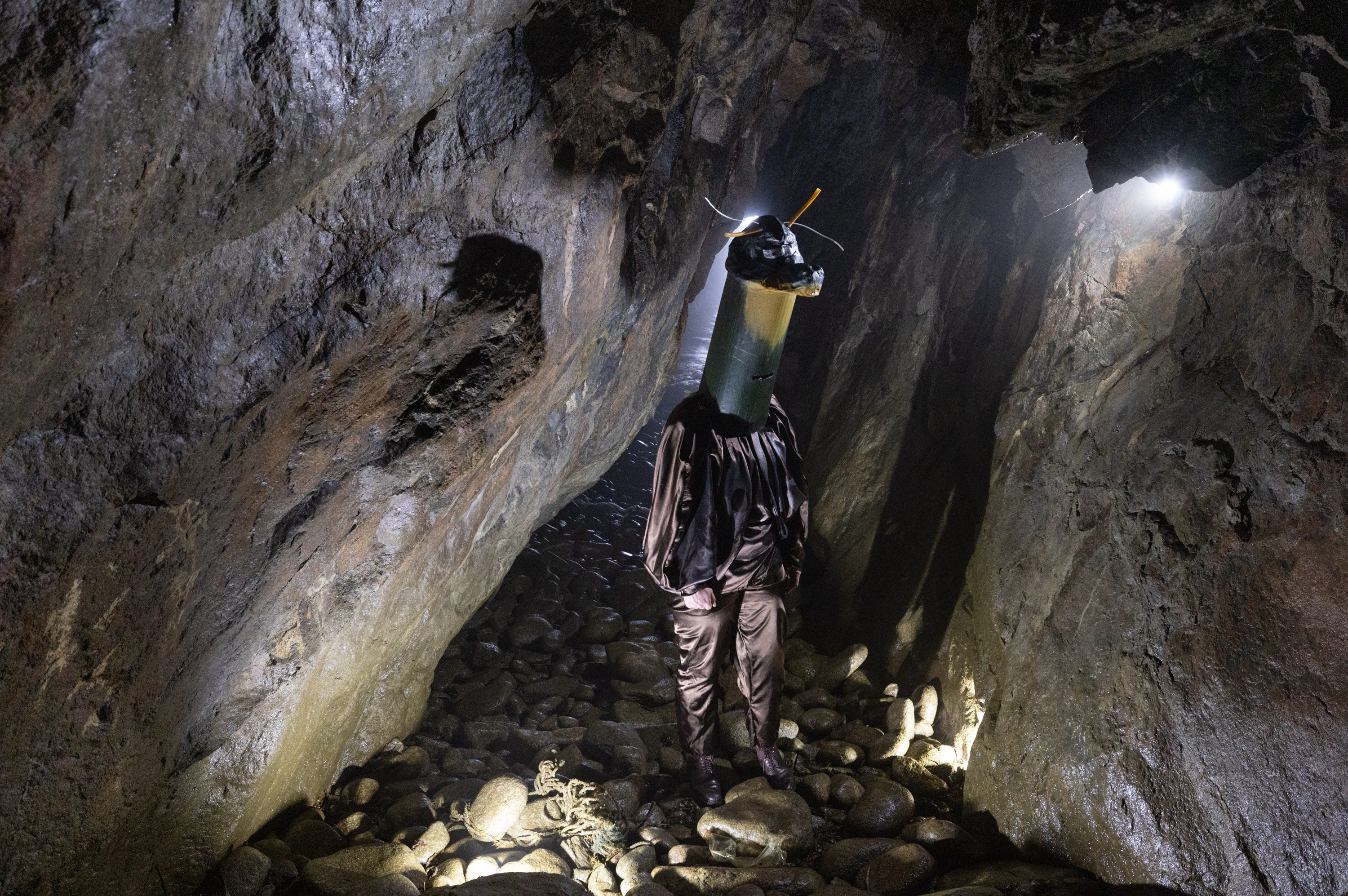
On a headland in Burra on the west coast of Shetland, a man walks his dog. Beneath his feet waves are frothing a fine mist up through a sea cave between orange-daubed rocks, a 1970 F-1 film camera and a woman dressed as the Loch Ness monster.
Miriam Sentler has spent much of her day walking through crowded places in costume – first a fiberglass fish, then a Papier-mâché pig and now a celebrity monster – but this is the first time she sounds nervous. “Can you maybe check the waves a little bit?” she says, pulling at a large cardboard cylinder covering her head. “Like, if there’s a big one come get me. Or scream. Or something.”
Sentler is not just any Loch Ness monster, but a picture-perfect recreation of acostume created exactly half a century ago for Up-Helly-Aa: Shetland’s faux-Viking fire festival, which descends into a booze-soaked, burlesque series of late-night-turned-early-morning satirical sketches in local halls.
She found the costume in an act called Ness Monstrosities: “a reference to both the recent furore about the Loch Ness monster and about the proposals to put oil in underground caverns on Calback Ness”, according to that week’s Shetland Times.
In one sense, that explains why she is in a cave, in a uniquely impractical costume, having her photograph taken. In another, it explains nothing at all.
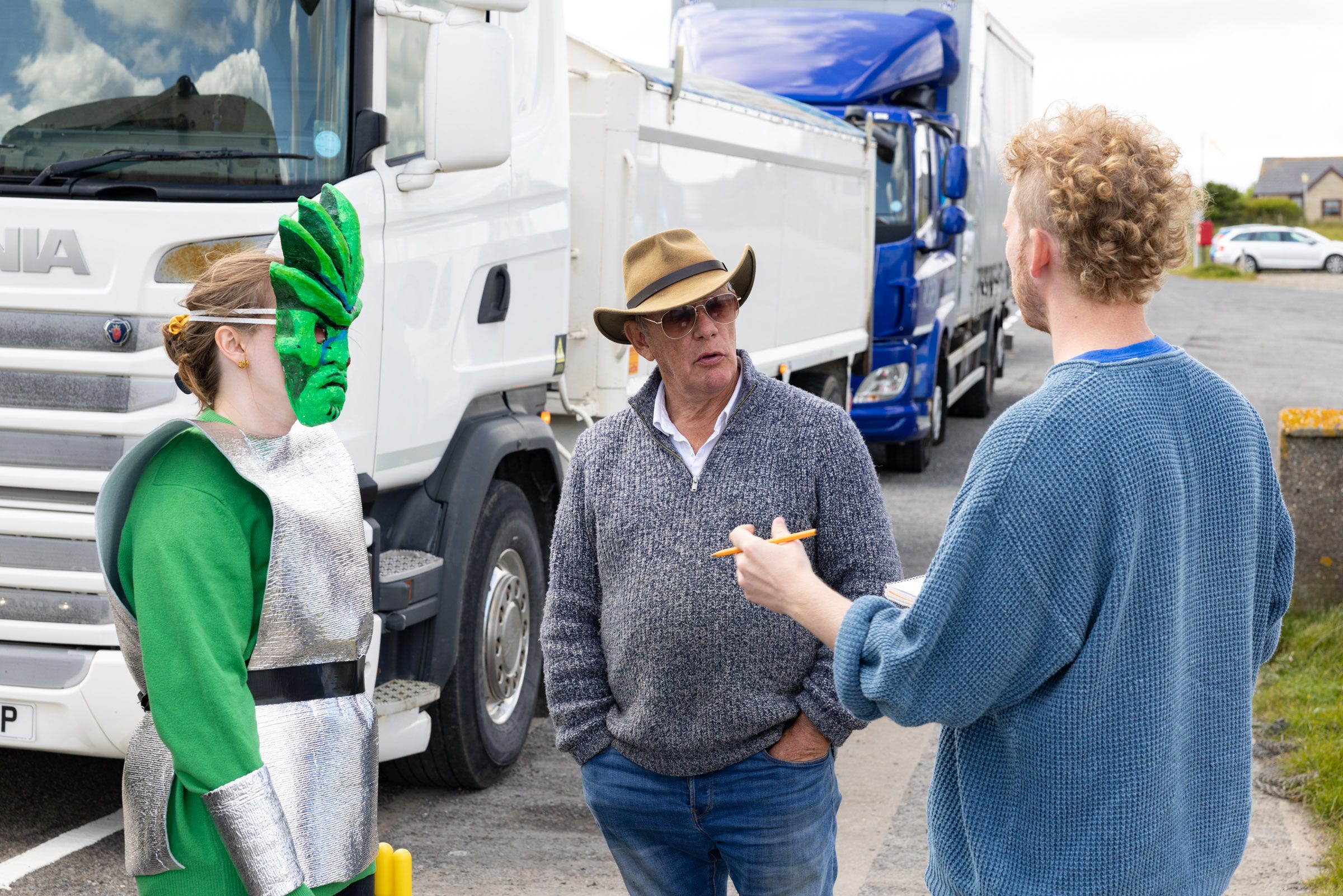
Sentler is from the Deep Time Agency, a Dutch performance-art-cum-research initiative. With collaborators Wouter Osterholt and Anna Tudos she spent a week in Shetland performing The Moving Energy Theatre. Nessie is just one of a van-full of Up-Helly-Aa costumes — picked because they somehow relate to energy — which the three performer-researchers wore around the isles, posing for pictures and starting conversations.
I followed the trio from Sandwick to Sullom Voe, across town and underground, through bewilderment and mockery — to find out if Shetlanders are still telling stories about the energy around them.
“These days most energy discourse is about interviewing,” Sentler says. She might equally have said consultations, or council meetings or hundred-page scoping reports. “We wanted to re-animate that.” By presenting a procession of old acts the team hoped not only to break each act out of the newspaper archives, but also pull conversations about energy back into the places which have been impacted by it. “It’s about inspiring different ways of talking about it,” says Sentler, “vernacular ways of reacting to energy.”
Some costumes are intuitive enough. A turbine wearing a ganzie marks the arrival of wind energy to Fair Isle in the 1980s. A fish appears in 1973 when Scalloway crews protested the oil terminal at Sullom Voe. Five years later half a squad dressed simply as the Shell logo, complete with pale yellow gimp masks.
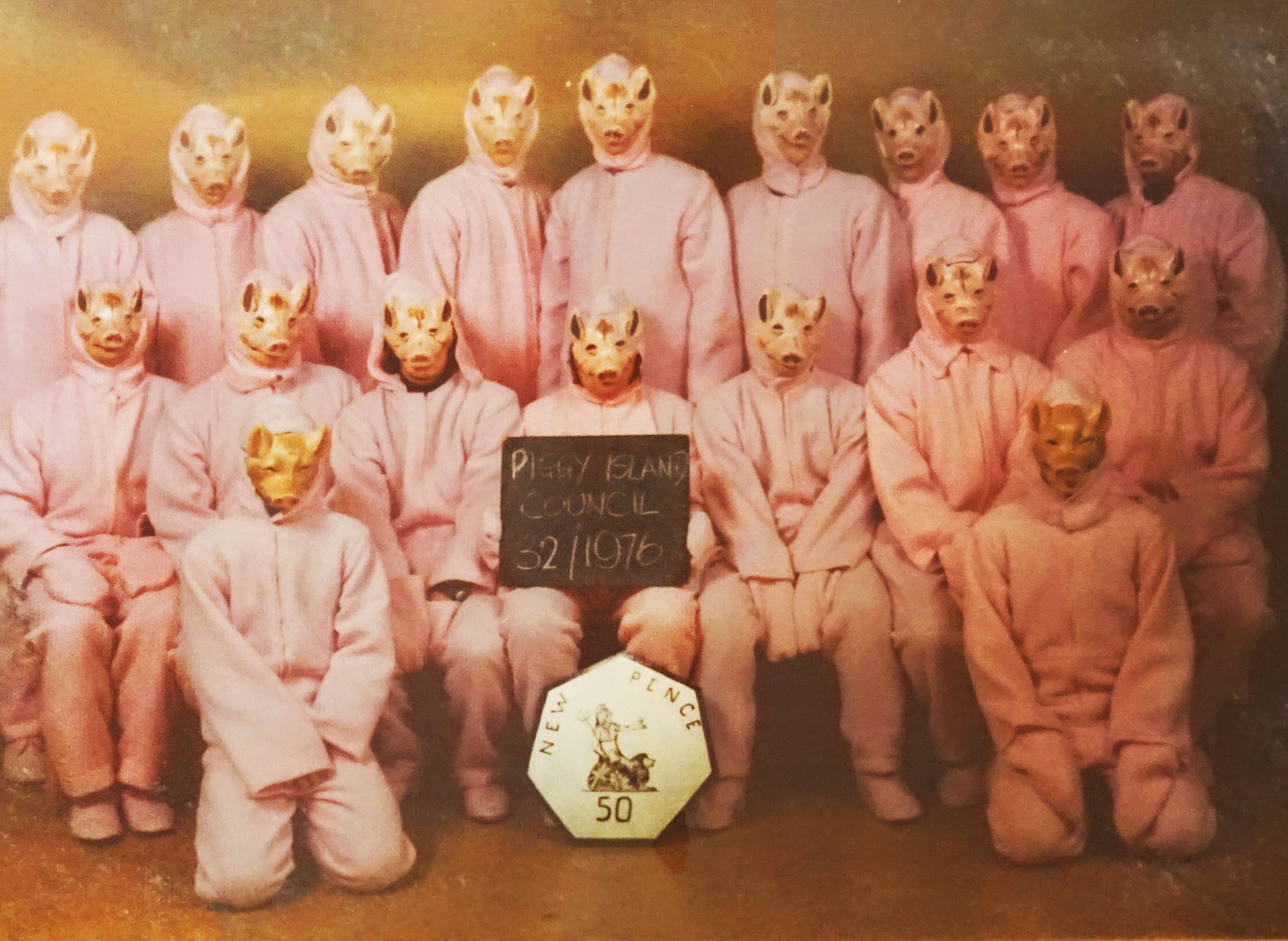
Others are more complex. Pig costumes are inspired by a technical piece of industry kit (Pipeline Inspection Gadgets). A green alien combines the 1960s Stingray puppet show with a local tidal array of the same name, and Nessie is some loose combination of a hair-brained start-up, national Nessie news and the passing of the 1971 Animal Act.
“Some of them are really stupid,” says Sentler. “There’s also some racist ones.” Plenty more are plain baffling. One called Grab a Granny involves a complex subterfuge about the actual number of grannies and happens to include “an oil man … dancing a quickstep”.
Sentler began trawling the archives two Up-Helly-Aas ago, after seeing a contemporary act called Just Stop Oil. Soon she noticed a pattern. The earliest photos preserved from the 1920s have acts about gas and peat here and there. “Then from the seventies onwards the oil acts become very activist,” says Sentler. “They become more grotesque and satirical and more site- specific.”
She doesn’t necessarily mean “activist” in the manner of a protest group like Extinction Rebellion. Rather, it’s a Punch and Judy style of mockery. In the Shell act, for example, the animated logos crawl around and bark like dogs. The fish-people in another complain about being covered in oil, then run in a circle singing a song.
Whatever the acts were making fun of, it is clear Sentler is not making fun of them. She can list them by name like she is recalling fine bottles of wine (“Shetland Sheiks, 1973”) and the entire trio are serious about the un-seriousness of their inspiration. For them this is a performance, but also research. A way of gathering information about energy without a survey or a questionnaire.
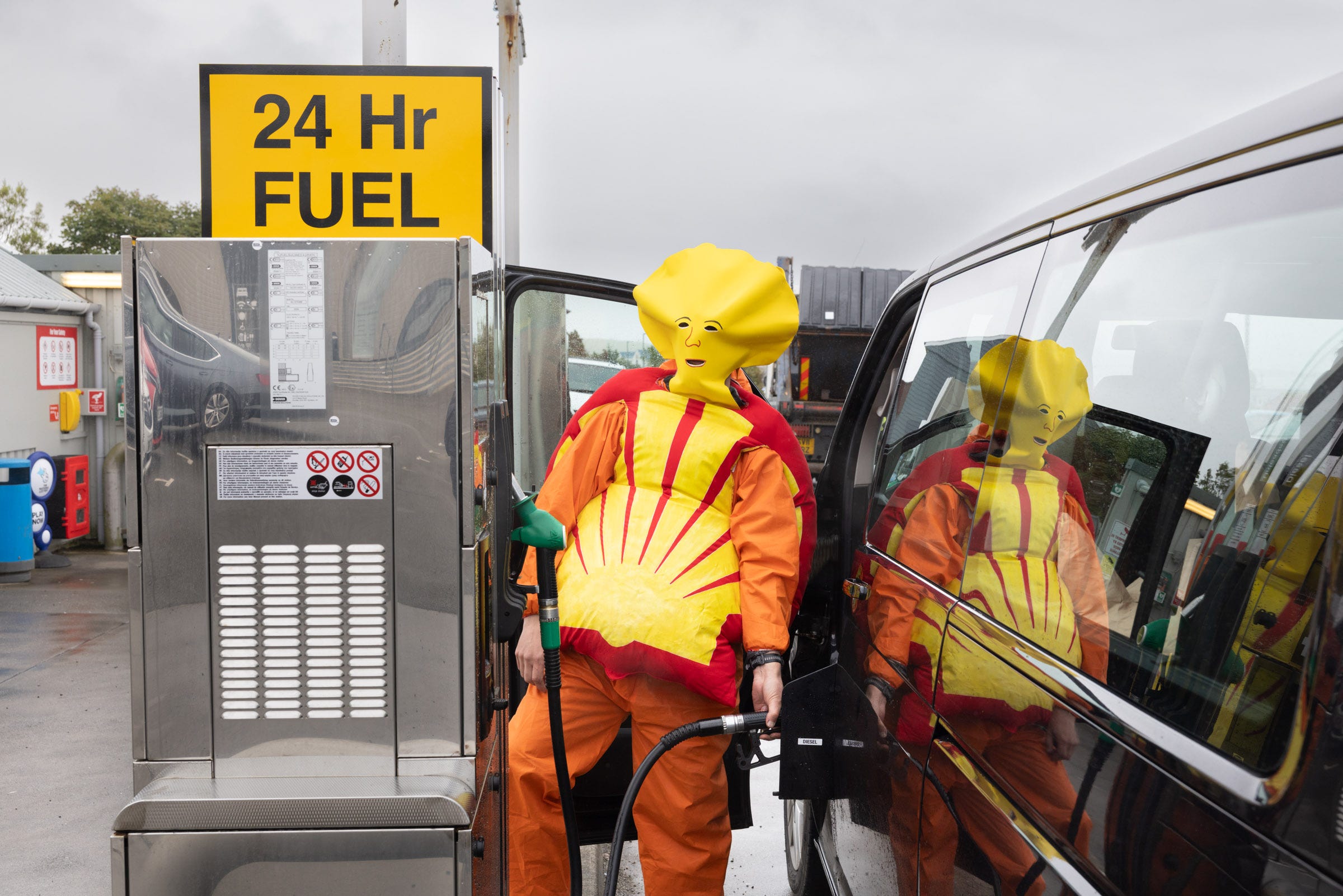
Wherever it goes, the Moving Energy Theatre is met with a degree of friction. Managers at various businesses are not pleased to see them. There are predictable jibes about losing a bet. One woman calls Osterholt a “twat”, as he fills up with petrol in the Shell costume. “I find those first encounters so beautiful, but also so scary,” he admits later that day. “So uncomfortable. They have no logic. It’s weird. It’s beautiful. I really love it.”
This abrasiveness is interesting in its own right. I’m struck by how confrontational some of the costumes instinctively seem once they’re removed from a drunken hall and into the light of a Lerwick lunch hour. But beneath some of these glancing encounters other threads emerge. Some tell stories about the heydays of Sullom Voe like a Xanadu of oily lucre.
“Everybody was there,” says Arnie Hansen, who built camps for workers at Toft. “It was incredible. The wages we had from our employer — BP doubled them.” The protests of fishermen, it seems, are largely forgotten.
There is plenty of myth-making about wind energy too. Lynn Mackensey, visiting from Argyll, says the turbines remind her of H. G. Wells’ Martian war machines. A birder, Renee Cleaver, thinks they are prettier in France. “It’s almost like a work of art the way they do it.”
One local mother, Anna, confesses she quite likes the windfarm, but is so conspiratorial about this she won’t give her last name. Many more are skeptical, if not outright bitter. The group are repeatedly told that Shetland has gained nothing from the Viking project (a 103 turbine windfarm, Britain’s biggest on land), despite it setting up the largest fund for community benefit from a renewables project in British history.
Leaning against his car in a loose shirt and gold chain, a retired driving instructor called Terry Smith heckles Sentler with a gentle cockney accent as she walks past the Burra hall in her Nessie costume. He moved to Shetland with the oil boom, then worked for decades behind the wheel. For a moment he pretends to be more interested in Sentler’s opinion, then he begins:
“Shetland was about the only place in Britain where the skyline was untouched. But now look at it.
“Have you heard about the lady that lived in the halfway house? She used to get up in the morning and listen to the birds singing. Then the birds moved away.
“The Burn of Lunklet — they say that’s been contaminated. It’s gone.
“I only have to look over there at night and you see red lights everywhere.”
Sentler asks if Smith ever protested against Viking, or got involved in the planning process. “My voice would be thrown into the wind,” he replies.